NEET 2027 Goes CBT: The Biggest Change to India's Medical Exam in a Decade — Full Guide

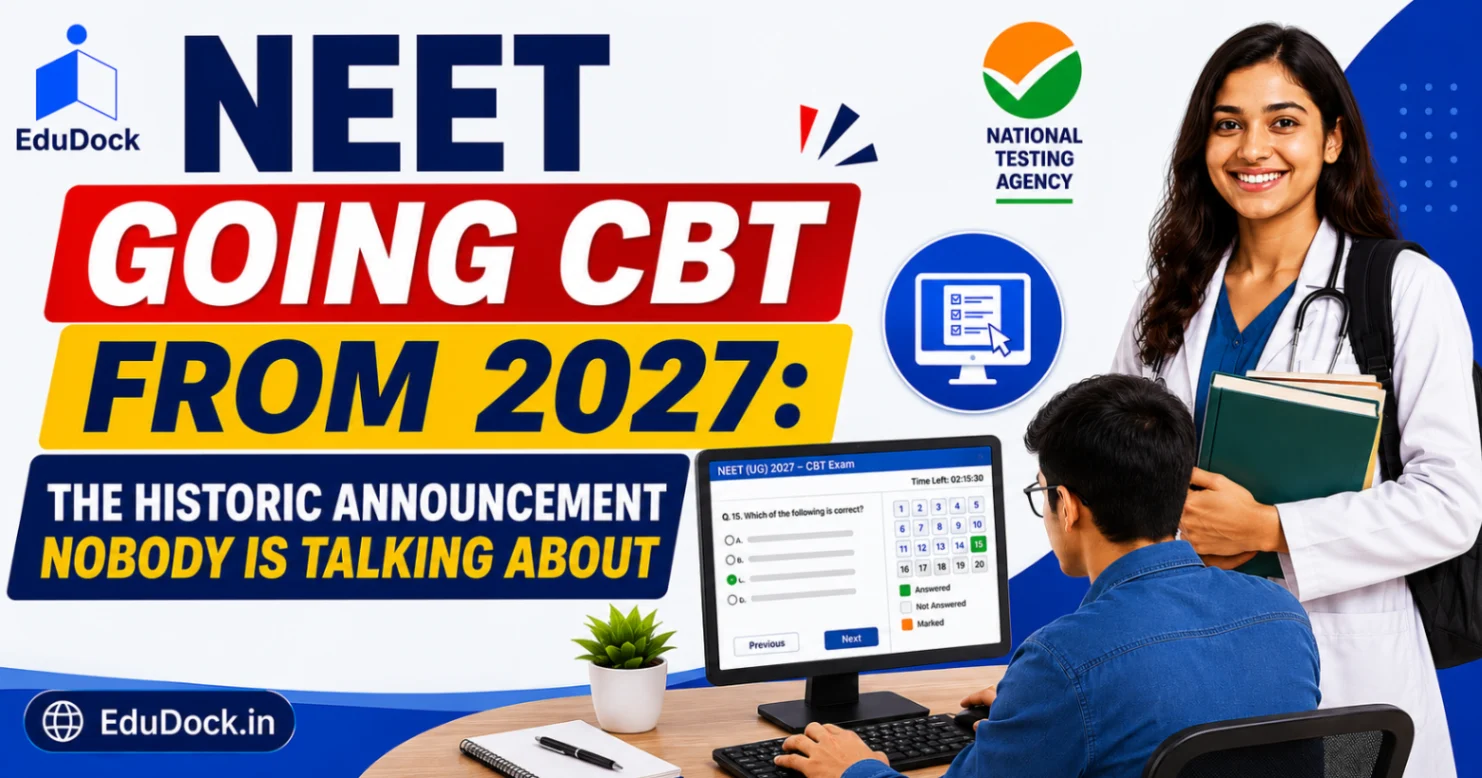
Table of Contents
- The 2026 Paper Leak That Triggered Everything
- The Official CBT Announcement and What Was Said
- The Radhakrishnan Committee Background
- What Changes in NEET 2027 CBT Mode
- What Stays Exactly the Same
- The Unanswered Question Shifts and Normalisation
- Infrastructure Plan 400 to 500 CBT Centres Across India
- Important Dates at a Glance
- How to Prepare for NEET 2027 CBT Right Now
- Frequently Asked Questions
- Sources and Verification
Picture this: you have been practising on OMR sheets for months. You have the pencil-darkening technique down to a science, you know exactly how much pressure to apply, and your erasing skills are practically a sport at this point. Then — overnight — the government says: none of that matters anymore. NEET is going fully online. 😮
Yes, really. This is not a rumour, not a "likely soon" prediction, and not an unofficial leak. Union Education Minister Dharmendra Pradhan officially confirmed on 15 May 2026 that NEET-UG will transition to a fully Computer-Based Test (CBT) format starting from 2027. It is, without exaggeration, the single most significant structural change to India's medical entrance exam in over a decade — and EduDock has dug into every official source, every expert statement, and every operational detail so you don't have to.
Whether you're currently in Class 10, Class 11, or preparing for a second NEET attempt, this guide covers everything: what caused this change, what exactly is different, what stays the same, and most importantly, what you should be doing right now.
The 2026 Paper Leak That Triggered Everything
On 3 May 2026, approximately 22.79 lakh students across India sat down to write the NEET UG 2026 examination in the traditional pen-and-paper format — just like every year since NEET was first introduced. For many of them, this moment was the culmination of two or three years of relentless studying, sleepless nights, and enormous financial investment by their families.
And then everything fell apart.
On 7 May 2026, the Rajasthan Police Special Operations Group (SOG) uncovered a "guess paper" that contained 140 exact questions that had appeared in the NEET 2026 exam. 😡 This was not a coincidence. The questions had been leaked before the exam, meaning some candidates had advance access to the paper. Central agencies were immediately brought in. As the investigation widened and breaches were confirmed across multiple states, the NTA took the only responsible decision available to it.
On 12 May 2026, the NTA officially cancelled the NEET UG 2026 examination — an exam that had already been written by nearly 23 lakh students. The CBI was called in to conduct a deep-dive probe, and a re-examination was announced for 21 June 2026, still in pen-and-paper mode, as what will now go down in history as the final traditional NEET.
What made this especially damning was that the government had already implemented the complete set of recommendations from the Radhakrishnan Committee — put in place specifically after the 2024 paper leak scandal. And yet the 2026 leak happened anyway, in the exact same OMR-based system the committee had flagged as the root vulnerability. The government was left with no choice but to make the final, irreversible call: eliminate the OMR system entirely.
The Official CBT Announcement and What Was Said
On 15 May 2026, Education Minister Dharmendra Pradhan held a press conference and delivered the statement that every future medical aspirant needed to hear. His exact words, as reported by ANI and multiple national media outlets, were unambiguous:
"Despite implementing the Radhakrishnan Committee's recommendations word for word for both 2025 and 2026, this incident occurred. The root cause is the Optical Mark Recognition (OMR)-based examination system. From next year, the NEET exam will be conducted in Computer-Based Test mode."
This was not a pilot or a trial. This was a permanent, confirmed structural shift.
In the same press conference, the minister also confirmed several other important details that directly affect current candidates. ✅ The NEET UG 2026 re-examination will be held on 21 June 2026 and will be the last-ever pen-and-paper NEET. Candidates who appeared on May 3 do not need to re-register; they will be automatically included in the re-exam. Application fees already paid will be fully refunded. Candidates will receive 15 extra minutes — the exam will now run from 2:00 PM to 5:15 PM. The CBI will conduct a full investigation into the 2026 paper leak, and the minister stated categorically that no one involved would be spared.
The NTA Director General Abhishek Singh added a crucial operational detail for the 2027 transition: accommodating NEET's roughly 2.2 million candidates in CBT mode would require approximately 20 shifts, and a normalisation process — similar to what is already used for JEE Main and CUET — would be necessary to maintain fairness across those shifts.
The Radhakrishnan Committee Background
To fully understand why the CBT decision makes sense — and why it took this long — you need to understand the Radhakrishnan Committee. 🔍 This was a 7-member high-level panel formed on 22 June 2024, in the direct aftermath of the NEET UG 2024 paper leak controversy. It was chaired by K. Radhakrishnan, the former Chairman of ISRO and a deeply respected figure in Indian governance.
The committee's analysis of the OMR system was comprehensive and unflinching. Physical question paper printing creates exposure at every single stage of its journey: at the printing press, during transport (in a notorious 2024 incident, a question paper was reportedly being carried on an e-rickshaw when it was stolen), at regional storage points, and inside exam centres themselves. Each of these touchpoints is a potential leak, and no amount of process improvement can fully eliminate human-caused failure in a physical paper chain.
Among the committee's key recommendations were the following. Shift NEET-UG to a fully computer-based format as the most reliable long-term solution to paper leaks. Create a national network of 400 to 500 dedicated CBT centres within approximately one year, leveraging existing Kendriya Vidyalaya (KV) and Jawahar Navodaya Vidyalaya (JNV) infrastructure. Implement a normalisation process for multi-shift exams, a method the NTA already successfully applies to JEE Main. Consider restricting the number of NEET attempts, which are currently unlimited.
The government implemented every recommendation for 2025 and 2026 — every recommendation except the CBT shift, which required time and infrastructure preparation. When 2026 produced yet another catastrophic leak, the final recommendation could no longer be delayed.
What Changes in NEET 2027 CBT Mode
This is the part that every current Class 11 student needs to clearly understand. Let's compare the old and new formats side by side. 👇
| What Changes | Until 2026 | From 2027 |
|---|---|---|
| Exam medium | Pen and paper, OMR sheet | Computer screen, mouse/keyboard |
| Question delivery | Printed physical booklet | Encrypted digital server |
| Answer marking | Darkening circles on OMR | Clicking on-screen options |
| Number of shifts | Single nationwide shift | Multiple shifts (~20 estimated) |
| Paper leak risk | High — physical transport chain | Significantly reduced |
| Result processing | Manual OMR scanning | Instant digital processing |
How CBT Delivery Works in Practice
When you enter a NEET CBT exam centre from 2027 onwards, here is what you will experience. 🖥️ You will be seated at a designated computer terminal. The question paper will be loaded directly from a centrally encrypted server — there is no physical question booklet at any point. Questions will appear on screen exactly as they do in printed form, complete with diagrams, chemical structures, and all standard formatting. You select your answer by clicking the option. You can flag questions for review and navigate freely between all 180 questions at any point during the exam. If there is a technical failure at your terminal, buffer and backup systems are mandatory at all certified NTA centres.
This workflow is already standard for JEE Main, CUET, and dozens of other NTA exams. NEET is simply the last major examination to make this transition.
What Stays Exactly the Same
Here is the critically important part that every student panicking about this change needs to read clearly. 🟢 The mode is changing. The content is not. Not a single academic parameter is being touched.
| Parameter | Status for NEET 2027 |
|---|---|
| Syllabus (Physics, Chemistry, Biology) | Fully unchanged |
| Total marks | 720 marks |
| Total number of questions | 180 questions |
| Section A and Section B split | Unchanged |
| Negative marking | -1 mark per wrong answer |
| Exam languages available | Unchanged (13 languages) |
| Eligibility criteria (age, attempts, qualification) | Unchanged |
| Conducting body | NTA remains the authority |
If you are currently studying NCERT Biology Chapter 6, practising thermodynamics numericals, or building your revision notes on human physiology — keep going. Every chapter you study today is 100% valid for NEET 2027.
The Unanswered Question Shifts and Normalisation
This is the part of the NEET 2027 CBT story that remains unsettled — and it may be the most consequential thing to follow. 👀
Here is the mathematical reality: 22.79 lakh students appeared for NEET 2026. The NTA's current CBT infrastructure can accommodate approximately 1.5 lakh students per shift. To cover the entire candidate pool in CBT mode, the exam would therefore need to run across approximately 20 shifts, spread over several days.
Now, the moment you have multiple shifts, you have a fundamental fairness challenge: the set of questions in Shift 1 may be slightly harder or easier than the set in Shift 15. The standard solution is normalisation — a statistical method where raw marks are adjusted based on relative performance across shifts. The NTA already uses this successfully for JEE Main, and the results have been broadly accepted by courts and candidates alike.
However, the health ministry had previously resisted a multi-shift NEET specifically because of normalisation concerns. Their stated preference was a single nationwide shift — "One Nation, One Exam" — to guarantee every candidate faces the exact same paper under identical conditions. In a merit-based exam where a single rank separates a medical seat winner from a loser, any formula-based adjustment introduces a statistical layer that students and legal petitioners may challenge.
The practical problem is simple: you cannot conduct a single-shift CBT examination for 23 lakh candidates. The infrastructure does not exist. 💡 So as of now, the government and NTA are actively working out the exact shift pattern and normalisation model for NEET 2027, and detailed operational guidelines are expected to be released well before the exam cycle begins.
What you should watch for: The NTA's official NEET 2027 notification will specify the shift pattern, normalisation methodology, whether the exam will run across one day or multiple days, and how the score equating process will be communicated to candidates. This notification is your most important document. EduDock will cover it the moment it drops.
Infrastructure Plan 400 to 500 CBT Centres Across India
One of the most legitimate concerns raised about online NEET — especially from parents and students in rural areas — is whether candidates from small towns and remote districts will have equal access to functioning, high-quality computer centres. 🏫 It is a completely fair concern, and the Radhakrishnan Committee addressed it with a concrete proposal.
The plan is to build a national network of 400 to 500 dedicated, high-security CBT examination centres within approximately one year, primarily by leveraging the existing KV and JNV school network. India has over 1,200 Kendriya Vidyalaya schools and over 600 Jawahar Navodaya Vidyalayas distributed across virtually every district, many of which already have computer labs with power backup infrastructure. Repurposing these as certified NTA exam centres is both operationally feasible and cost-effective.
Beyond government schools, the NTA is also expected to empanel engineering colleges and universities that are already certified for JEE Main and CUET — institutions that already possess the required infrastructure of biometric entry systems, CCTV surveillance, server connectivity, and generator backup.
The concern about rural students being disadvantaged is real and should not be dismissed. However, ed-tech experts have noted that today, even students in remote regions routinely use smartphones, digital platforms, and school computer labs. The old argument that rural students lack basic computer familiarity is significantly weaker than it was a decade ago. That said, the NTA is expected to provide free practice sessions at designated CBT centres before NEET 2027, specifically to help first-generation computer users get comfortable with the interface.
Important Dates at a Glance
| Event | Date |
|---|---|
| NEET UG 2026 Original Exam Conducted | 3 May 2026 |
| NTA Officially Cancels NEET UG 2026 | 12 May 2026 |
| Education Minister Confirms CBT from 2027 | 15 May 2026 |
| Re-NEET 2026 Admit Card Release | 14 June 2026 |
| Re-NEET 2026 Exam (Last Ever Pen-Paper NEET) | 21 June 2026 |
| Detailed NTA NEET 2027 CBT Guidelines | Expected by end of 2026 |
| NEET 2027 — First Ever CBT NEET | To be announced by NTA |
The Re-NEET 2026 on June 21 will be conducted from 2:00 PM to 5:15 PM, giving candidates 15 minutes more than the standard duration as a relief measure announced by the Education Ministry.
How to Prepare for NEET 2027 CBT Right Now
Here is the good news wrapped inside the anxiety: you have time, and the vast majority of your preparation does not change at all. 🎯
Start Practising on Computer Based Mock Tests
This is the single most impactful new addition to your preparation routine. Instead of — or in addition to — solving questions on paper, you need to regularly sit through full-length mock tests on a computer screen. The NTA already runs a free mock test platform at ntaonline.in for JEE Main in CBT format. Dedicated NEET CBT mock tests are expected to be added well before the 2027 cycle begins.
The new skills you are building through this practice are: reading long Botany passages on a screen without losing focus, using the on-screen flagging system to mark-and-revisit questions strategically, getting comfortable with the countdown timer displayed live in the corner of your screen, and managing eye fatigue across a full 3 hour and 15 minute session.
Your NCERT Studies Are Completely Unaffected
Nothing about your academic preparation changes. NCERT Biology, NCERT Chemistry, and NCERT Physics are still your foundation — full stop. Your chapter-wise notes, previous year question banks, formula sheets, and concept maps are 100% valid for NEET 2027. The CBT interface is just the delivery vehicle. The content inside is identical.
Monitor the NTA NEET 2027 Notification Closely
The single most important document for your NEET 2027 preparation will be the NTA's official NEET 2027 notification — expected several months before the exam. It will contain the shift pattern, exam city allocation process, normalisation methodology (if applicable), and updated admit card timelines. EduDock will publish a full breakdown the moment this notification is released.
Frequently Asked Questions
Will NEET 2027 be conducted in CBT mode officially
Yes, this is 100% officially confirmed. Union Education Minister Dharmendra Pradhan announced it in a press conference on 15 May 2026, stating clearly that the OMR-based system is the root cause of paper leaks and that NEET will shift permanently to CBT from 2027 onwards.
Does the NEET 2027 syllabus change because of CBT mode
No. The subject syllabus, number of questions, marks distribution, and negative marking pattern are completely unchanged. The only change is in the medium through which you answer: a computer screen instead of an OMR sheet.
I am in Class 11 right now and should I be worried about CBT
Not about the content. Your NCERT preparation is fully valid. The only practical addition to your routine should be regular computer-based mock tests to get comfortable with the digital interface, on-screen navigation, and the live timer. The subject knowledge you build remains the core asset.
What if I do not have computer access at home to practise
The NTA is expected to offer free CBT mock sessions at designated centres before NEET 2027. Additionally, most school computer labs, cyber cafes, and public libraries provide computer access. The NTA's own free mock test portal is accessible from any internet-connected device, including a smartphone, which helps bridge the gap for candidates without home
Last Updated: 28 May 2026 | Published by: EduDock Research Team | Category: NEET, Medical Entrance Exams, NTA Updates | Fact-Checked: Yes — all dates and figures cross-verified across a minimum of 3 independent sources.
Don't miss the next one
Get a weekly digest of new updates, PDFs, and tools — no spam, unsubscribe anytime.
More in this category

SVMCM Scholarship ₹12,000 Scheduled to Credit on 9 July 2026 — Check Your Bank Account Now
Jul 9, 2026
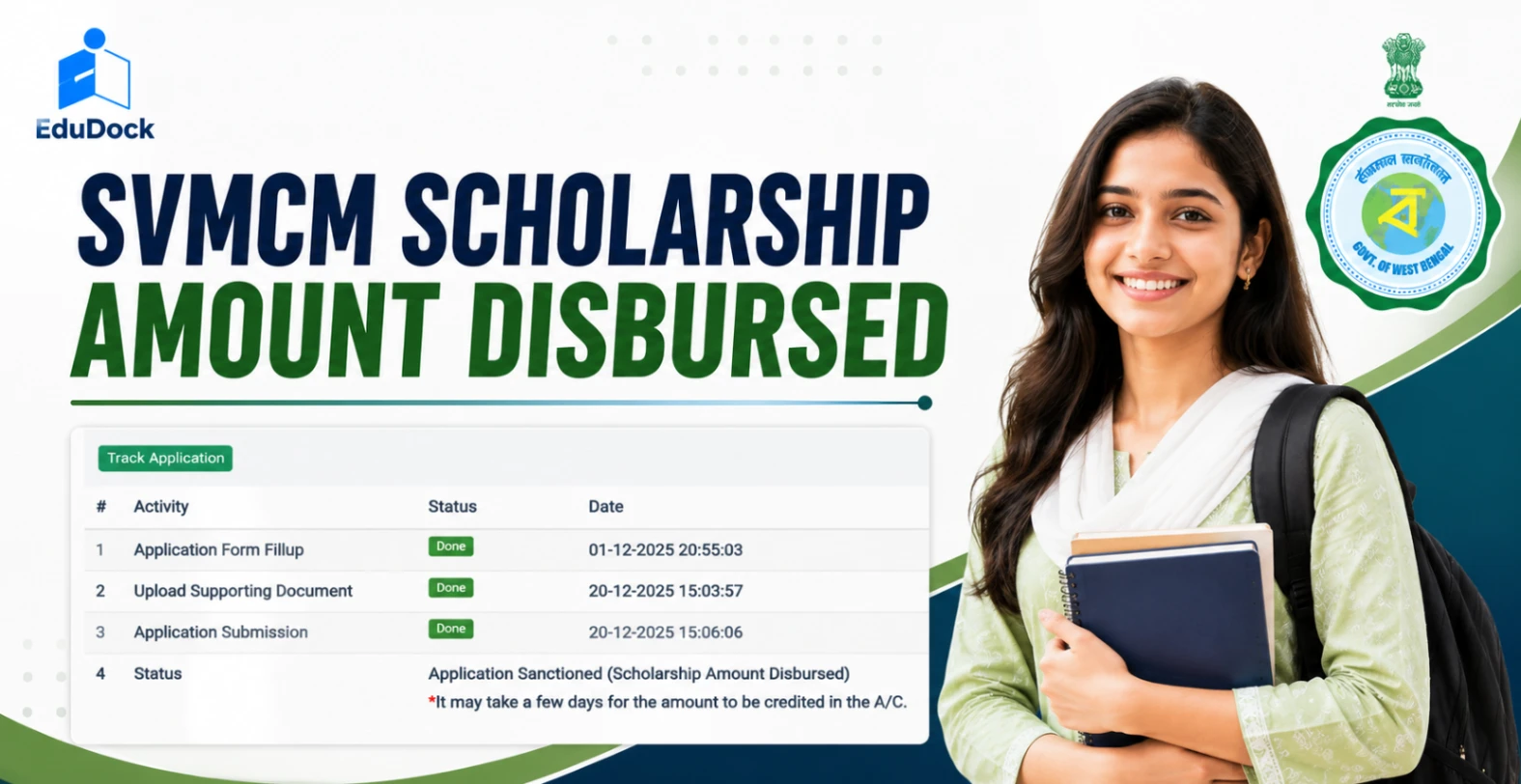
SVMCM Scholarship 2025-26: Amount Disbursed — Full Course-Wise Breakdown & Status Guide
Jun 26, 2026
CUET UG 2026 Result OUT — How to Download Your Scorecard, Toppers List & What to Do Next
Jun 25, 2026
Annapurna Bhandar Status Check 2026 — Track Application & ₹3,000 DBT Payment On
Jun 23, 2026